Det finns ett par riktigt bra sidor när det kommer till att verkligen djupdyka i hårdvaruprestanda. Oftast anser vi Digital Foundry vara den mest trovärdiga (vilket gör att de ofta figurerar som källa), men en annan av topparna är Wccftech. Och de har nu postat en rejäl genomgång av vad vi kan vänta oss från Playstation 5 - med en något överraskande slutsats. De anser helt enkelt att Sonys uppgivna beräkningskapacitet på 10,3 TFLOP är vilseledande:
"Things get murkier though, while Microsoft's reveal was excruciatingly clear, succinct and allowed third-party testers like Digital Foundry to get closeups out, I found the Sony Playstation 5 reveal to be somewhat lacking in clarity and almost, deliberately vague. My primary pain point was when the Sony PS5 was advertised to ship with 10.3 TFLOPs and then the words "variable clock rate" were uttered in the same breath. This, as many of you have guessed is misleading."
Orsaken till varför Sonys angivna värde inte är helt tillförlitligt förklaras såhär:
"Sony PS5 has something called a variable clock rate. What that means is that the console will not run the GPU at 2.23 GHz all the time. Since Microsoft's clock is a static number, just because PS5's clock rate is variable makes the 10.28 TFLOPs number uncomparable to the Xbox Series X and misleading. This is because XSX is displaying the "sustained TFLOPs" figure while PS5 is displaying the "peak TFLOPs" figure."
Wccftech hävdar att Microsoft faktiskt kan ha underklockat Xbox Series X, och om även de hade satsat på en variabel lösning för klockfrekvensen, så hade de kunnat nå betydligt högre än uppgivna 12 TFLOPS med Xbox Series X:
"Microsoft might actually have underclocked its own console to make way for a "fine wine" philosophy as we have seen in the past. In fact, if they were to approach a dynamic clocking philosophy as well, they can hit an astounding 14.6 TFLOPs figure (using the PS5 clocks) - which is absolutely insane for a console. That said, you don't want to do that. Optimizing games is hard and having a static clock with no power fluctuation shenanigans is always easier to work with than a dynamic approach."
Lyckligtvis avslutas artikel med något som de flesta lär kunna enas om oavsett när vi snackar prestanda; 'PC master race' är fortfarande nummer ett:
"NVIDIA has retained its performance crown (as always) at 16.1 TFLOPs on the RTX 2080 Ti but just barely."
Ett diagram med Wccftechs slutsatser hittar du här nedan. Vad tror du om detta?
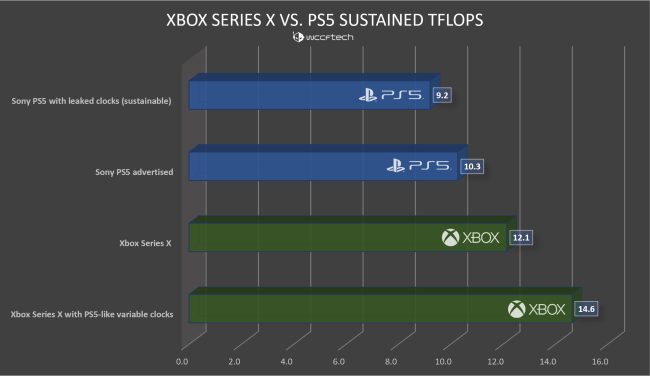
Bild från Wccftech